
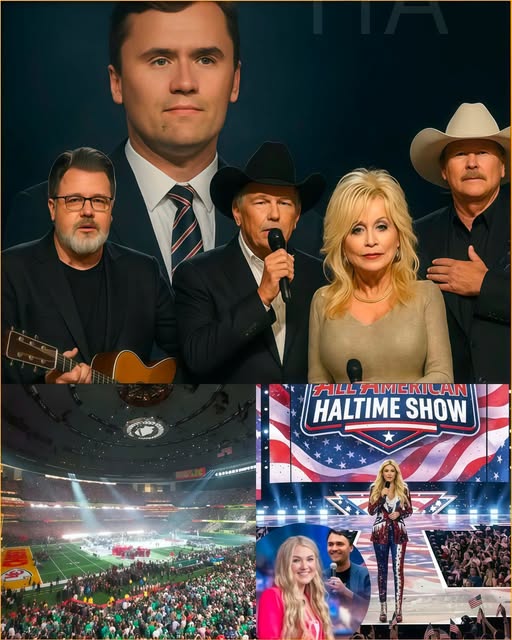

What was expected to be a familiar, carefully choreographed moment in the annual Super Bowl spectacle has instead ignited a national conversation about culture, politics, and the limits of artistic participation on America’s largest stage. According to reports circulating among entertainment and sports media circles, several legendary figures in country music—including Alan Jackson, Dolly Parton, George Strait, Vince Gill, and Reba McEntire—collectively declined participation in the Super Bowl halftime show after objecting to a proposed tribute they reportedly viewed as politically charged. While organizers have not publicly confirmed every detail, the decision has already reverberated far beyond the stadium.
The Super Bowl halftime show has long been more than a musical interlude. Over the decades, it has evolved into one of the most scrutinized and influential entertainment platforms in the world, capable of shaping narratives and sparking cultural moments in a matter of minutes. Because of that reach, every creative choice—song selection, imagery, guest performers—carries weight. In this case, sources familiar with the matter suggest that the artists’ discomfort stemmed not from the scale of the event, but from concerns that the tribute crossed a line from commemoration into political signaling.
The reported refusal reportedly caught organizers off guard. Planning for the halftime show typically begins months, if not years, in advance, with careful coordination between the league, broadcasters, sponsors, and performers. A collective withdrawal by artists of this stature is rare, particularly given their longstanding influence across generations of American listeners. While none of the artists has issued a detailed public statement outlining their objections, their decision alone was enough to spark intense speculation and debate.
Almost immediately, social media platforms became the battleground for competing interpretations. Some fans praised the musicians for standing by their principles, arguing that the Super Bowl should remain focused on sport and shared celebration rather than ideological messaging. Others criticized the move, contending that artists have always used prominent stages to reflect the social realities of their time and that refusing participation is itself a political act. The central question repeated across posts, panels, and opinion columns was deceptively simple: should the Super Bowl be politically neutral, or is neutrality itself no longer possible?
The debate highlights a broader tension that has been building for years. As American culture becomes increasingly polarized, institutions once viewed as unifying—sports leagues, award shows, national ceremonies—are finding it harder to remain untouched by political meaning. The halftime show, watched by tens of millions both domestically and abroad, sits at the crossroads of entertainment and symbolism. Even when intentions are framed as honoring history or values, audiences often interpret them through the lens of current divisions.
Country music occupies a particularly complex space within this dynamic. Long associated with tradition, storytelling, and a wide spectrum of political views, the genre’s most iconic figures have often avoided overt political alignment, choosing instead to emphasize shared human experiences. For artists like Jackson, Parton, Strait, Gill, and McEntire—whose careers span decades—the decision to step back from such a prominent platform may reflect a desire to preserve that broad, inclusive appeal.
Industry analysts note that declining a Super Bowl halftime appearance carries its own risks. The exposure is immense, and participation can introduce artists to new generations of listeners. Turning it down suggests that the artists involved weighed those benefits against the potential cost to their values or reputations. Whether their objections were rooted in specific content, broader concerns about precedent, or a desire to avoid being drawn into controversy remains a matter of interpretation.
The response from organizers and broadcasters has been notably measured. Rather than escalating the situation, officials have largely refrained from public comment, a choice that may be intended to prevent further polarization. Behind the scenes, however, the incident has reportedly prompted renewed discussions about how halftime concepts are developed and approved. Some insiders suggest that future shows may face increased scrutiny from both performers and audiences, with greater attention paid to how tributes and themes are framed.
Beyond the immediate logistics, the episode has fueled a larger conversation within the entertainment industry about boundaries. Artists are increasingly aware that participation in high-profile events can carry unintended associations. At the same time, audiences are more attuned than ever to symbolic meaning. What one group sees as a celebration of values, another may interpret as advocacy. Navigating that divide has become one of the defining challenges for mass cultural events.
Media scholars argue that the controversy reflects a shift rather than an anomaly. The Super Bowl, like other major cultural touchstones, no longer exists in a vacuum. Its halftime show is not simply evaluated on musical merit, but on what it appears to endorse or challenge. In this context, the refusal by prominent artists becomes part of the narrative, reinforcing the idea that opting out can be as impactful as performing.
For many viewers, the most striking aspect of the situation is what it reveals about the current moment. The Super Bowl has long been marketed as a unifying event, a rare occasion when people across political, regional, and generational lines share a common experience. Yet the controversy underscores how fragile that unity can be when cultural symbols become contested terrain.
Whether the reported walkout will have lasting effects remains uncertain. The halftime show will go on, as it always does, and audiences will debate its merits and meaning in real time. But the episode has already left its mark by exposing fault lines that are difficult to ignore. It has prompted artists, organizers, and fans alike to reconsider what they expect from entertainment—and what they are willing to accept when it intersects with larger cultural conversations.
One conclusion, however, appears unavoidable. The Super Bowl halftime show is no longer judged solely as entertainment. It has become a reflection of the cultural tensions shaping the country, a mirror in which disagreements about identity, values, and expression are projected onto a single, globally watched stage. Whether that reality is embraced or resisted, it is now part of the event’s legacy, shaping how future moments will be imagined, negotiated, and received.