
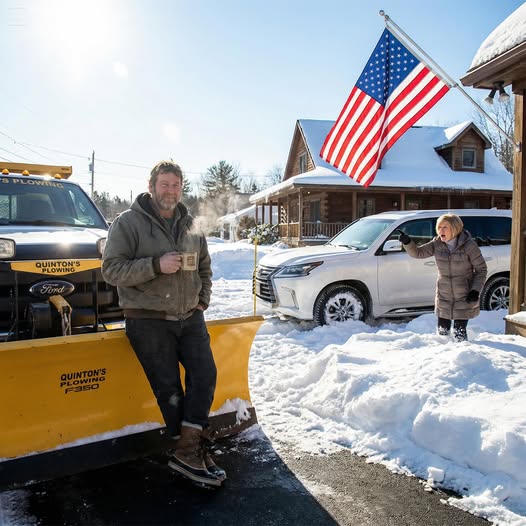

“HOA Fined Me $200 For Idling My Truck While I Plowed Their Streets For FREE During A Blizzard, So I Paid The Fine And Parked My Plow Forever. Then The Snow Started Falling, The Garbage Trucks Stopped Coming, And The Board President Who Said “”Rules Are Rules”” Found Herself Facing Felony Charges When The Snow—And Her Secrets—Piled Up Too High.
The fine came on a Tuesday morning in mid-January. Slipped under my windshield wiper while I was inside grabbing coffee after clearing 6 inches of fresh snow from every street in Meadowbrook Estates. I stood there in the Quick Stop parking lot, steam rising from my travel mug, staring at the bright yellow paper that accused me of violating community code section 12.4-B.
“”Excessive vehicle idling on association property. $200 fine. Due immediately.””
I’m Quinton Harper, and I’d been plowing snow for Meadowbrook Estates in suburban Minneapolis for three winters. Not because the HOA hired me, mind you. I owned property there, a decent two-story colonial I’d bought after my contracting business took off. And I had a commercial-grade Ford F350 with an 8-ft plow attachment that I used for my day jobs.
Every time it snowed, I’d wake up at 4 in the morning and clear every single street in our development before heading to my paying gigs. Did it for free. Did it because I grew up in Minnesota and understood what “”neighborly”” meant.
The development had 47 houses spread across eight streets, all winding through what used to be farmland. The city plowed the main road that led to our entrance, but everything inside our gates was supposedly our responsibility. The HOA charged us each $200 monthly for maintenance and services, but I’d never once seen them arrange for snow removal.
Most winters, people just stayed home during storms or drove through the mess carefully until the sun melted enough to make things passable—until I started plowing anyway.
I walked back to my truck, the fine still in my hand, and checked my phone. 7:30 in the morning. The HOA president, a woman named Patricia Hendris, didn’t typically show her face before 9, but her little sidekick, Karen Whitmore, was probably already prowling around looking for violations.
Karen was the community manager, a title she wielded like a weapon, and she’d made it her personal mission to find something wrong with every property at least once a month.
I drove home slowly, my plow raised, thinking about the absurdity of it all. The fine cited three separate instances over the past 2 weeks where my truck had been observed idling for longer than 5 minutes while parked on association streets.
What they failed to mention was that during those instances, I was outside my truck shoveling someone’s driveway by hand because they were elderly or disabled. Mrs. Chen on Ashwood Court was 83 and lived alone. The Robinsons on Maple Drive had a son with cerebral palsy and their driveway was on an incline that became treacherous when icy.
I couldn’t just plow and run. I helped people.
My wife, Amanda, was getting ready for work when I walked in. She took one look at my face and knew something was wrong.
“”What happened?””
I handed her the fine. She read it twice, her expression shifting from confusion to anger. “”This is because you plowed the streets? They’re fining you for helping everyone?””
“”Apparently, my truck idles too long.””
“”Your truck needs to idle in this cold or it’ll stall out. It’s -5° outside. Are they insane?””
“”Probably just Karen being Karen.””
“”You need to fight this.””
I shook my head, already forming a plan that was probably childish, but felt absolutely necessary.
“”No, I’m going to pay it. And then I’m never plowing another street in this neighborhood again.””
Amanda studied my face. “”You’re serious?””
“”Completely. They want to fine me for helping? Fine. Let them figure it out themselves.””
The next snowfall came 4 days later. I woke up at my usual 4 in the morning, looked out the window at the 6 inches of fresh powder glowing under the streetlights, and rolled over and went back to sleep.
When I left for work at 7, I took my truck out through streets that hadn’t been touched. My plow stayed raised. I drove carefully, my four-wheel drive handling the conditions easily, and I didn’t feel a single pang of guilt.
By noon, my phone started buzzing. Text messages from neighbors asking if I was okay, if the plow was broken.
I responded to each one with the same message: “”Got fined by the HOA for plowing. Won’t be doing it anymore. Sorry.””
I didn’t know it then, but that single decision—to pay the fine and park the plow—would trigger a chain reaction that would expose years of corruption, lead to felony charges for the Board President, and change our neighborhood forever.
Read the full article below in the comments ↓”