
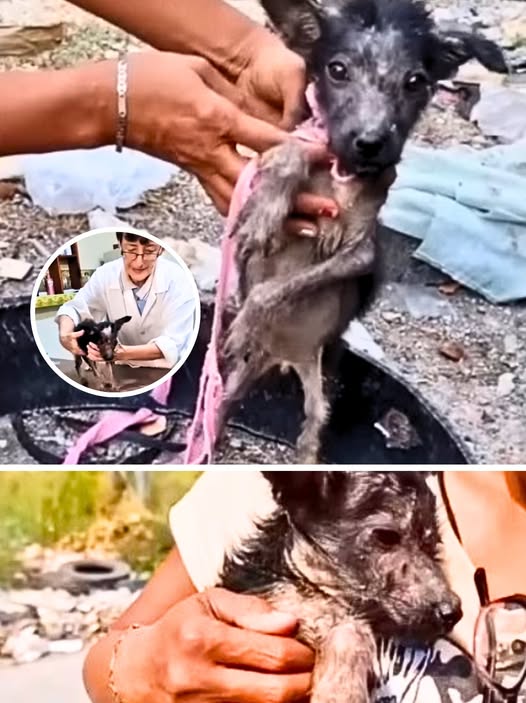
The photos released by the rescue team tell a story that words alone struggle to carry. In them, a small dog stands tethered to a narrow roadside, surrounded by trash and decay, his chain cutting short every possible movement. The road is quiet, almost forgotten, but the evidence around him makes one thing painfully clear: he had been there for a long time, unseen and uncared for.
One of the rescuers later admitted that the moment still haunted him. There were no dramatic cries or frantic movements when they arrived—just a small, gentle dog standing exactly where he had been left, as though he had learned that leaving his spot was no longer an option. The ground around him was littered with waste, a silent indicator of days spent chained without food, water, or relief. It was not just neglect. It was endurance forced upon a life that never asked for it.
When they approached, the dog did not resist. He did not bark or pull away. He simply looked up, eyes filled with confusion and quiet acceptance, as if unsure whether this moment would bring help or more disappointment. The chain was removed, and with it, the weight of days spent trapped in the same few feet of space.
They named him Armor.
The name felt fitting—not because he had been protected, but because he had survived something no dog should have had to withstand. He was rushed to a veterinary clinic immediately, where the full extent of his condition became clear. Armor was severely dehydrated, his body weakened by prolonged neglect. His muscles lacked strength, his movements slow and hesitant, as though even standing required careful calculation.
The examination revealed even more pain beneath the surface. Armor was suffering from painful fungal infections and a severe case of scabies, leaving his skin raw, inflamed, and constantly irritated. Every scratch, every flinch, spoke of discomfort that had gone untreated for far too long. This was not the result of a missed meal or a bad week. This was long-term abandonment etched into his body.
The veterinary team acted quickly. Fluids were administered to rehydrate him. Medication was started immediately to address his skin conditions. Gentle hands worked carefully, mindful that trust would take time. Armor’s body was weak, but his spirit—quiet and observant—remained present, watching everything with cautious hope.
Within a week, the first signs of change appeared.
His eyes softened. His movements became steadier. After proper bathing and consistent treatment, his skin began to heal, and with relief from constant pain came something even more powerful: curiosity. Armor started responding to voices. He showed interest in his surroundings. He began to eat on his own again, slowly recovering from the near-starvation state he had been living in.
There were no promises made about how much he would recover or how long it would take. But what mattered was that he was no longer fighting alone.
A month later, a new photo told a very different story.
Armor no longer looked like the dog found chained on the roadside. His posture had changed. His eyes held light instead of fear. His body showed strength instead of fragility. When the rescue team shared his story, the response was immediate, and before long, Armor found something he had likely never known—a real home.
Two months later, the transformation was undeniable.
With consistent care, nutritious meals, and something even more important—stability—Armor blossomed. His coat grew thick and shiny. His skin healed fully. His once timid presence gave way to confidence, playfulness, and trust. The dog who had stood quietly beside trash and chains now moved freely, engaging with the world as if discovering it for the first time.
Armor’s journey is not just about rescue. It is about what happens when suffering is met with compassion instead of indifference. When someone chooses to stop, to look, and to act.
Today, Armor’s life looks nothing like the one captured in those first heartbreaking photos. He is no longer defined by what he endured, but by what he was given afterward—care, patience, and love. And his story stands as a reminder that even the most neglected lives can be rewritten when someone decides they are worth saving.