
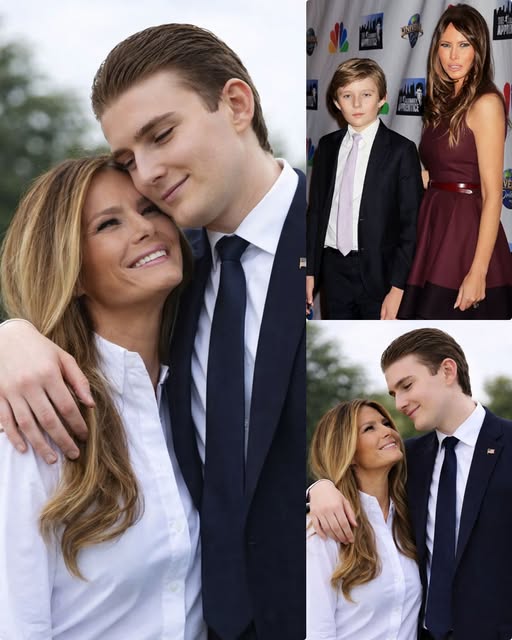
There were no cameras in the room.
No speeches prepared.
No audience waiting for a moment to be shared.
It was meant to be an ordinary family evening — quiet, informal, and intentionally separate from the public world Melania Trump has lived in for decades. Yet what unfolded that night would become one of the most emotionally revealing moments those present had ever witnessed from her.The moment came without warning.
Barron Trump stepped forward holding a small, carefully wrapped gift. It was modest in size and plain in appearance, offered without explanation or ceremony. There was nothing about it that suggested significance beyond sentiment.
Melania smiled instinctively, the familiar smile of a mother receiving something from her child.
Then she opened it.
A SILENCE THAT CHANGED EVERYTHING
The room fell completely silent.
Those present later described the shift as immediate — not dramatic, but unmistakable. Melania looked down at what lay inside the wrapping, then slowly looked back up at her son. Her smile faded. Her hand rose to cover her mouth.
For several seconds, she couldn’t speak.
Years in public life have trained Melania Trump to remain composed. As First Lady and long before that, she was known for her restraint — carefully controlled expressions, measured reactions, and an emotional distance often misread as detachment.But in that moment, surrounded only by family, that composure dissolved.
She began to cry.
WHAT BARRON GAVE HER — IN FULL
The gift was not jewelry.
It was not memorabilia.
It was not symbolic or decorative.
Barron had given his mother a small handwritten manuscript — a notebook he had personally prepared after watching early cuts of her upcoming documentary.
Inside were pages of detailed notes written in his own hand.
Barron had watched the documentary carefully, scene by scene, not as an audience member or critic, but as a son. He wrote about moments that stayed with him, scenes that carried emotional weight, and details that outsiders might miss but felt profound to someone who had lived that life alongside her.
Several entries focused specifically on Melania’s role as a mother.
He wrote about the sacrifices she made quietly — choices she never explained publicly, decisions shaped by protection rather than ambition. He reflected on how often her strength was mistaken for coldness, and how the documentary captured only a fraction of the emotional cost behind that strength.
This was not analysis of a film.
It was recognition.
At the back of the notebook was a short handwritten letter.
“This is how I see you,” Barron wrote.
“Not as the world does — but as my mom.”